
Hyper Flux™ UVC 740
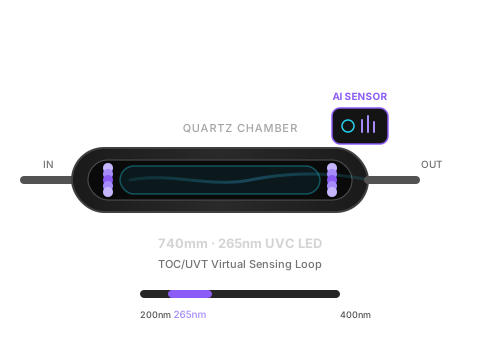
Quartz chamber · 265nm irradiation · Real-time sensing loop
Click a marker or tag below to explore each reactor module.


AquaLux · 265nm UVC LED
Hyper Flux™ UVC 740 combines non-thermal 265nm UVC physical disinfection with adaptive dose control and AI virtual sensing (TOC/UVT). It maintains process water quality while quantifying energy savings and carbon reduction for semiconductor, AI liquid cooling, quarantine tanks, hospital ST108, and cosmetic PW applications.
Hyper Flux™ UVC 740 is our flagship smart water quality system, integrating extreme UVC disinfection with real-time digital diagnostics. The Ø46×744 mm / 265nm reactor delivers 479.2 mJ/cm² (Standard) and 584.6 mJ/cm² (Boost) per unit—up to 1,753.8 cumulative in 3S—using AI virtual sensing to detect TOC/UVT fluctuations and quartz fouling—eliminating process water uncertainty.
Our team brings Taiwan's high-power photonics and embedded control expertise to recirculating water disinfection. Non-thermal UV replaces energy-intensive heating, while adaptive dose control reduces over-powering of fixed-output systems—supporting net-zero management and ESG reporting.
From semiconductor UPW and AI data center CDU biofilm prevention to quarantine-tank water supply, hospital ST108 critical water, and cosmetic PW pretreatment, we provide modular hardware, the Hyper Flux monitoring platform, and 24/7 cloud diagnostics—upgrading water treatment from a black box to traceable data assets.
Click a marker or tag below to explore each reactor module.
With the same disinfection outcome, sensor feedback and dynamic control upgrade water disinfection from high-energy fixed-power equipment to a quantifiable, energy-saving smart system.
CFD (Computational Fluid Dynamics) numerically simulates how water actually moves through the chamber, revealing the helical motion inside and the acceleration zone at the outlet.

Particle traces show helical flow inside the chamber and acceleration at the outlet (0–2 m/s), validating residence-time distribution and dose uniformity.
Simulation source: SimScale
From the velocity field and particle traces, residence time distribution (RTD) is computed to confirm whether mainstream paths cluster within a consistent time window.

The Integration Time histogram peaks near 1.95 (mostly 1.9–2.1), indicating highly consistent flow paths and dwell times—key input for validating dose uniformity.
Simulation source: ParaView
With RTD established, optical geometry and cross-sectional irradiance are simulated to verify uniform W/cm² along the chamber and combine with RTD for overall UV dose consistency.

Receiver cross-sections maintain 0.432–0.441 W/cm² along the chamber length, radially decreasing from center to wall; combined with RTD above, this validates uniform dose accumulation.
Hyper Flux total-internal-reflection optics turn every watt into usable light.
In conventional products, light leaks and dissipates along the path—much of the energy is wasted before it ever arrives. Hyper Flux builds its optical structure on total internal reflection, keeping light reflecting forward inside the chamber and driving losses toward zero — with the same energy, no matter the distance, light arrives at its fullest. This is not just brighter; it is the ultimate use of light.
Simulation source: Keysight

Equipped with a high-efficiency heat-pipe cooling system that effectively manages waste heat from low UVC electro-optical conversion, keeping the UVC light source module running at peak performance.
Multi-stage or continuous power adjustment based on real-time flow and UV intensity feedback maintains target disinfection dose. Eco / Normal / Boost modes prevent over-powering at low load and under-dosing at high flow.
Integrates flow, UV intensity, output power, cumulative treated volume, energy use, and anomaly events into a complete operational history. Traceable data supports audits, preventive maintenance, and DCIM integration.
Non-thermal physical disinfection eliminates heating and holding energy plus downstream cooling load. The system calculates unit energy, savings rate, annual kWh saved, and carbon reduction for ESG and net-zero policies.
Bypass or inline integration with existing recirculation loops, configured by site flow, pipe diameter, and space. Standardized modules shorten integration from biotech labs and commercial cooling to data center liquid cooling.
From AI facility water and semiconductor transfer lines to livestock, quarantine tanks, cooling towers, dairy, hospital ST108, and cosmetic PW pretreatment—one traceable 265nm UVC platform across eight industries

Liquid cooling is not the end—heat still leaves the CDU into facility water (FWS). OCP sets a live-bug limit while systems run (100 CFU/mL), yet many halls sample only quarterly—nearly ninety blank days on the books. Sidestream filters miss 0.5–2 µm bacteria; halogens collide with corrosion and warranties. HyperFlux UVC 740: 265nm, sidestream quick-connect, continuous, no chemistry—every dose and UVT logged. We keep it in spec. We don't scrub your pipes.

Fabs SPC temperature, pressure, and particles in real time. The thing that grows still goes to culture—results arrive days later. Ralstonia-class organisms survive in UPW and seed dead legs and long transfer lines; filters do not catch them. HyperFlux UVC 740 applies continuous 265nm sidestream protection on central-to-bay transfer, reclaim, and recovery paths—dose and UVT logged per segment. We don't touch your polish loop. We guard everything before it.

Between batches you clean and disinfect the lines. On wean-to-finish farms, wall counts rebound by day three after a peracetic flush and exceed pre-clean levels within two weeks—not because you didn't clean, but because chemistry can't reach inside the film. Cleaning is scheduled; contamination is continuous. HyperFlux UVC 740 runs continuously on each house line—suppressing the load in the water and slowing attachment, with zero residue. Established film still needs terminal physical cleaning—we don't overclaim. Every dose is logged for vets and integrators.

Most quarantine pathogens arrive with the fish—UV cannot treat the fish, and we say that first. HyperFlux UVC 740 guards the water between tanks: one unit per tank or tank group, up to 25 L/min, dose and UVT logged continuously and filed per tank; no mercury, no chemical residue—it does not interfere with salt or treatment baths. One kit for eel, koi, ornamental fish, and aquarium quarantine—same fresh water, same temperature band, same flow band. We don't promise survival rates. We document the water.

Sydney has required monthly Legionella testing for cooling towers since 2018; New York followed—monthly testing is becoming the default. Culture can take up to fourteen days, so the report is already two weeks old. Between slides, between cultures, before the report returns, treatment history is a blank. HyperFlux UVC 740 sidestream quick-connects, runs continuously, holds down planktonic load, and logs dose and UVT hour by hour for your water-management file. Your chemical program keeps every drop—we fill in the hours it can't see.

We promise one thing: the water that reaches the plate-cooler outlet (cow drinking water), AMS teat-wash water, and a calf's first water is drinking-water quality—and logged. Pinhole leaks in plate coolers are a known industry risk; robot wash water touches the teat; the calf's first week starts with that drink. HyperFlux UVC 740 sits on the cold feed—continuous logs, no chemical residue. Hot CIP stays yours. We handle the cold side.

ECRI's 2026 Top 10 health-technology hazards ranks sterilizer-water quality at number ten. Under ST108, critical water gets daily conductivity checks—but bacteria and endotoxin only monthly. Only one of those grows on its own. Equipment isn't evidence: even sites with RO, DI, UV, and ozone have run chronically out of spec. HyperFlux UVC 740 runs continuously on the loop—delivered dose and UVT logged per unit, not a percentage on a lamp. Monthly testing and sanitization stay; we step aside on bypass during sanitization. We don't do point of use. We keep the loop honest in between.

In 2025–2026, multiple recalls traced bacteria to water—softeners and carbon beds are necessary, yet they also grow biofilm; many small PW skids have no disinfection or log before the RO. Good manufacturing practice for cosmetics expects a disinfectable water system with monitoring. HyperFlux UVC 740 installs after the carbon bed and before the RO—265nm continuous, every dose and UVT filed; it steps aside on bypass during hot sanitization. We're not your PW system. We guard the water that feeds it.
Click cards for specs and the monitoring platform

Leave your contact details and we will reach out within 24 hours to arrange spec consultation, site assessment, or a Hyper Flux monitoring platform demo.
